
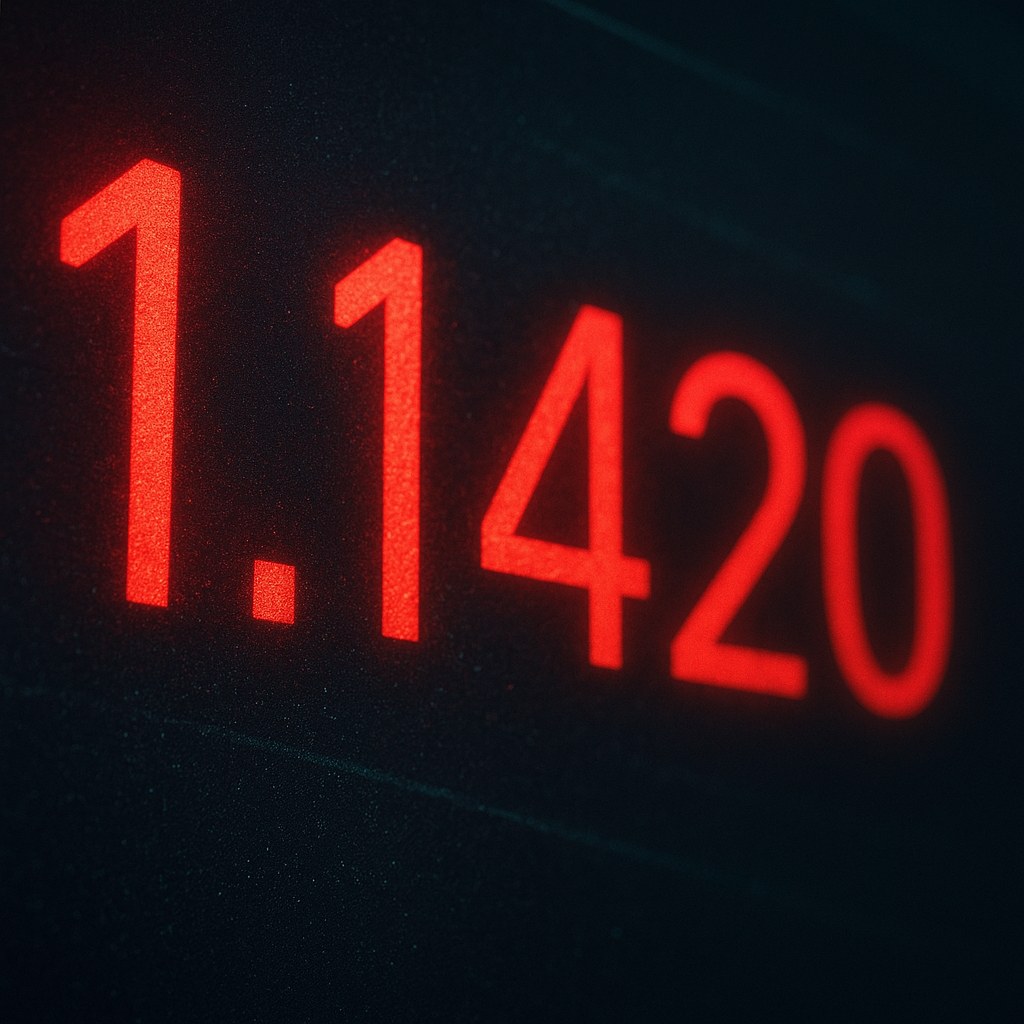
Market chatter is focused on one question: are eur/usd slips towards 1.14200 signalling a break from the recent trading range or a shallow pullback that offers tactical entry points? The euro’s movement back to this price cluster matters because it sits at the intersection of technical structure, central-bank differentials and shifting risk sentiment. Traders, hedgers and strategists are watching for clues that will determine whether momentum downgrades or reasserts.
In this note I isolate why the 1.14200 mark is pivotal, how geopolitical scenarios could swing the pair, and what traders are saying about near-term targets. The aim is practical: identify what to watch and how to frame risk if EUR/USD continues to slide toward 1.14200.
The Pivotal 1.14200 Level: A Deep Dive
The 1.14200 level acts as a technical and psychological pivot. It has historically served as a zone where order flow clusters — stops, limit orders and algorithmic references — converge. When EUR/USD approaches this pivot, market microstructure often shifts: intraday volatility can rise, and liquidity conditions change as market-makers and institutional desks reprice risk flows.
Why this matters beyond charts: the level represents a boundary between the euro’s recent consolidation and an extended trend leg. A decisive move below 1.14200 tends to invite short-term sellers who use momentum confirmation tools, while failure to hold it can attract buyers targeting mean reversion. Importantly, trading behaviour around the level is asymmetric — downside breaks tend to trigger faster moves than comparable bounces, because stop placement below the level can accelerate selling.
Geopolitical Impacts on EUR/USD Near 1.14200
Geopolitics is a wildcard for EUR/USD around 1.14200. European political risk — elections, policy disputes within the euro area, or sudden trade frictions — typically weighs on the euro, increasing the odds of a sustained slide. Conversely, geopolitical stress that affects global growth expectations can favour the dollar via safe-haven flows, pushing the pair lower.
Energy shocks or sanctions that hit European growth differentially will be particularly relevant: they can reduce ECB policy flexibility and alter rate-expectation differentials versus the Federal Reserve. Traders should monitor headline risk and keep an eye on risk-off proxies like core rates and sovereign spreads, which often lead currency moves when the pair approaches key pivots such as 1.14200.
Long-term EUR/USD Forecast: Beyond 2025
Looking beyond 2025, the euro’s path will be shaped by structural forces: relative growth trajectories, inflation convergence, and central-bank policy normalisation cycles. If euro-area growth reaccelerates and inflation stabilises at target with tighter real rates relative to the US, the euro could regain ground. Conversely, persistent US outperformance or a durable shift to safe-haven dollar demand would tilt the long-term balance toward lower EUR/USD levels.
Long-horizon scenario planning should incorporate rate differentials, trade and capital flows, and demographic growth trends. These fundamentals define a range rather than a precise line: 1.14200 sits inside that range as a tactical reference point, not a deterministic long-term anchor.
EUR/USD vs Other Majors: A Comparative Analysis
Near 1.14200, EUR/USD behaviour is best read in the context of other major pairs. If the dollar strengthens broadly — visible in DXY moves and crosses such as USD/JPY and GBP/USD — the euro is likely participating in a multi-currency dollar bid. If instead weakness is concentrated in the euro against multiple currencies (for example, underperforming vs. the pound), euro-specific drivers are more relevant.
- Cross-checks: watch EUR/GBP and EUR/JPY for signs of euro-specific stress or resilience.
- Correlation dynamics: correlations between majors can increase during stress; a sliding EUR/USD that coincides with a stronger USD/JPY signals broad dollar demand rather than isolated euro selling.
Expert Opinions and Trader Sentiment at 1.14200
Market participants range from tactical intraday desks to longer-horizon macro funds, and sentiment is mixed. Short-term proprietary desks often highlight order-book concentration near 1.14200, whereas macro managers focus on rate expectations and growth differential narratives. Retail sentiment tends to flip quickly around headline events, while institutional flows show more persistence.
Copy-trading and social platforms report increased attention to the level as a risk-management reference: some traders place smaller directional exposure with stops clustered around 1.14200, while others use the point as a re-entry zone. For those interested, STB’s resources on copy-trading and strategy notes explain how sentiment can be factored into execution, though this is informational and not investment advice.
Technical Analysis Overview
Support and Resistance Levels
Immediate support is concentrated at the 1.14200 pivot and zones just below where prior intra-day lows clustered. Resistance is defined by recent highs and moving-average confluences. Traders should treat the area as a zone rather than a single line — order book depth and time-of-day liquidity make the difference between a retest and a break-out.
Near-term Bias Overview
Near-term bias is conditional: a clean break below 1.14200 with follow-through volume favours a negative bias; repeated failures to break lower increase the chance of a corrective leg higher. Use momentum tools such as RSI and MACD on multiple timeframes to confirm bias shifts, and watch for divergence as an early warning of exhaustion.
Market Trends
Trend assessment should combine price action and macro indicators. If rates and risk sentiment support the dollar, the downtrend is more likely to persist. Conversely, stabilisation in euro-area data or a dovish turn in US rate expectations can flip trend indicators rapidly.
Price Targets
Price targets are scenario-dependent. In a bearish scenario, traders look to logical demand areas below the pivot where liquidity has been historically present. In a bullish reversion, targets are set at prior swing highs and key moving-average resistances. Apply risk-reward rules and avoid overleveraging around this highly watched level.
STB’s Perspective: Leveraging PAMM Accounts for EUR/USD Trading
STB Investment’s PAMM framework provides one such allocation model where experienced managers allocate based on macro and technical signals around levels like 1.14200. PAMM accounts allow investors to allocate to an expert portfolio rather than execute single trades themselves.
Note: CFDs and leveraged instruments carry substantial risk of loss. Past performance does not predict future returns. Consider your risk tolerance and diversification needs before allocating capital through PAMM or other managed solutions. For educational resources, see our guide on EUR/USD strategies at /forex-education/eur-usd-strategies and the PAMM overview at /pamm.
Frequently Asked Questions
What makes the 1.14200 level so critical for EUR/USD?
1.14200 is critical because it combines technical clustering (stops and limit orders), psychological significance and recent price history. It functions as a liquidity node where market participants reassess exposure, which can amplify moves when the level is tested or broken.
How do geopolitical events influence EUR/USD near 1.14200?
Geopolitical events alter growth expectations, risk appetite and safe-haven flows. Events that disproportionately affect the euro area or global growth can shift demand for the dollar or euro, making 1.14200 either a support or a springboard for further moves depending on the news flow.
What is the long-term outlook for EUR/USD beyond 2025?
Beyond 2025 the outlook depends on structural drivers: relative growth, inflation convergence, and policy paths. The pair is likely to move within a fundamental range shaped by these forces; 1.14200 is a tactical reference inside that broader context rather than a long-term anchor.
How does EUR/USD perform against other major currencies near 1.14200?
Performance versus other majors reveals whether moves are euro-specific or part of a broad dollar trend. If crosses show euro weakness across the board, the euro itself is under pressure; if only EUR/USD is weak while EUR/GBP or EUR/JPY hold, dollar-specific drivers may be dominant.
What are traders’ sentiments and price targets around the 1.14200 threshold?
Sentiment is mixed: some traders view 1.14200 as a buying opportunity for mean reversion, others see it as a stop-cluster to be sold through on momentum. Price targets vary by time horizon and strategy; risk management and position sizing are central given the level’s tendency to produce sharp intraday moves.
Conclusion
EUR/USD slipping toward 1.14200 is not just another quote move; it is a litmus test for liquidity, sentiment and the balance between macro fundamentals and technical structure. Traders should watch order flow, macro headlines and cross-pair behaviour to read whether the level will hold or give way.
For those considering allocation via managed solutions, the PAMM framework at STB provides one approach to gaining exposure while delegating execution decisions. Remember that leveraged FX trading carries significant risk—manage position size, employ stops, and consider educational resources before increasing exposure.
Ready to start trading?
Put what you've learned into practice.